Sunday, March 10, 2024

A year without Joy: part two

  I wrote a crazy long post about the 1907 Honolulu League season which I feel compelled to break up;  this is the second part of three. 

On June 1, after four unsuccessful attempts, Diamond Head finally won its first game. Eddie Fernandez, manager and shortstop of the Jewels, stole four bases, made three hits, and scored three runs, while left fielder Darcy stole four, hit two, and scored two as the Jewels beat Kamehameha 9-3. 

Eddie Fernandez. Advertiser, 1907-6-09, p.13

After just one home run had been hit the first four doubleheaders of the season, three were made in the Diamond Head-Kamehameha game alone. Bill Vannatta hit one; R. Leslie, Diamond Head first baseman, hit one; and Jones, Kamehameha catcher, hit one. 

Of the four homers that had been hit all year, qualifying their creators for free $5 suits from E.O. Hall & Son, Bill Chillingworth had allowed three of them. He was really doing his part to bolster his opponents' wardrobes. 

In the second game of the doubleheader, Andy Bushnell started his first game for St. Louis, and shutout the Punahou Colts on four hits. It was the first shutout of the season. 

On June 8, Kamehameha beat Punahou 4-0. Reuter scattered seven hits and struck out 10, while Bill Hampton gave up ten hits.

I'm not sure what Bill Hampton is trying to do here, but it doesn't look like he's succeeding at it. Advertiser, 1907-6-09, p.13 

In the second game, St. Louis beat the Diamond Heads in a tight game. The Saints were down 4-3 in the bottom of the eighth when, with Bill Chillingworth on the mound for Diamond Head, shortstop Evers led off with a single, and then Williams hit a grounder to first baseman Leslie, who fumbled it, making it first and third. Williams stole second and then "Akoni" Louis drove them both in with a single to put the Saints ahead 5-4, the final score. The game left St. Louis 5-1, and Diamond Head 1-5. 

Diamond Head would not lose again until July 6. 

On June 11, in a Tuesday doubleheader, St. Louis beat Kamehameha in a loose 11-7 game as the Kams made nine errors, and the Diamond Heads beat Johnnie Williams and Punahoe 7-3, collecting 14 hits. 

Hannah and Ringland, Punahou's right fielder and catcher, respectively, played their last game with Punahou on June 11. They were both members of the Tenth Infantry, which was being transferred to Alaska. 

Ringland had put up the second highest batting average in the league in 1906, with a mark of .380 for Oahu. He had fallen off in hitting in 1907, with a .250 average in seven games, but was still good. Hannah had been three-for-sixteen, but had played errorless ball in right. 


Ringland was replaced as Punahou catcher on June 15 by Charlie B. Lyman, of Oahu College. [Note: The Wikipedia page for Punahou School says that it was known as Oahu College until 1934. If that is true, then the Punahou of 1907 might have been a different school from the current Punahou, because it seems to me looking at newspapers of the time that Punahou School and Oahu College were different institutions. This is all rather confusing...]

Lyman had been playing in Hilo earlier in the year. In May there was voting for the most popular player in Hilo, and as of May 16, Lyman was 1st with 32 votes - 14 more than any one else. 

Lyman was well-regarded as a catcher in his time with Punahou. The Evening Bulletin declared on June 24 that: "Lyman's throwing in the first game was the best that has been seen all season... he [is] a tower of strength to the team." He had thrown out three runners in that first game. Lyman could also contribute offensively, hitting an excellent .261 with six stolen bases in five games, but after June 29 he returned to Hilo and was gone for the rest of the season. 

Major Van Vliet, also of the Tenth Infantry, played his last game at second base for the Diamond Heads on June 15. "A good many of the army people, beside scores of his friends and well wishers, were there to see him play." Van Vliet was rather ancient for a ball player, and hit just .118 in nine games, but he could still "cover ground... like a youngster." 

What cares an army man for father time? Advertiser, 1907-6-16, p.13

The Diamond Heads won Major Van Vliet's last game 7-1 against Reuter and the Kams, pounding out nine hits and stealing seven bases.

The Advertiser wrote on June 22: 
    "The departure of Major Van Vliet and Lieut. Hannah is much regretted; these men have aided materially in giving us good clean sportsmanlike ball. They have accepted defeat or victory with the same grace and the moral effect of their gentlemanly demeanor will not be lost."

In the second game of June 15, Punahous vs. St. Louis, there were three Deshas and four Williamses on the field. "When Williams as pitcher... threw the ball to Williams' first-base, to put out Williams' base-runner, it was a little confusing to the stranger."

But the Desha is mightier than the Williams. The three Deshas on the Punahous combined to score six runs as the Punahous smacked Evers, St. Louis shortstop pressed into mound duty, for twelve runs. 

Jack Desha. Advertiser, 1907-7-13, p.5


Before the game of June 22, a certain Mr. Whitney filled the baseball field's holes and rolled it flat, hopefully making it a pristine altar conducive to pristine fielding.

It worked. The smallest crowd of the season was in attendance, according to the Evening Bulletin, but they saw two great games.

If only more people had heard the call. Evening Bulletin, 1907-6-20, p.7

In the St. Louis-Diamond Head game, not a single error was made by either team. Just as remarkable as the fielding was the score: Diamond Head 3, St. Louis 1. Earlier in the year, St. Louis had been 5-1 and Diamond Head 1-5, but now the Saints had lost two straight games and the Jewels had won three straight. 

It had been feared for a time that the Diamond Heads would be just as bad in 1907 as the Maile Ilimas had been in 1906. It took a while, but the Diamond Heads didn't give up, and made themselves into a decent team. As the Advertiser wrote on June 15, when the Diamond Heads were still just 2-5: "The Diamond Heads are playing all the time and though they have not a star team, by keeping everlastingly at it, they have developed into a factor in the game. What an improvement over the old Mailes."

Bill Hampton of the Punahous beat Lota of the Kamehamehas 5-2, in another well-played game with just six total errors, and with that, the first series was finished. 

Lota. Advertiser, 1907-7-06, p.6

The final standings of the first series:

St. Louis, 6-3
Punahou, 5-4
Diamond Head, 4-5
Kamehameha, 3-6

St. Louis, Punahou, and Diamond Head all seemed well-positioned for the second half. The Saints, though shaky near the end, were the winners of the first series. Punahou was solid throughout the first half, and the Diamond Heads had finished very strong. Only Kamehameha seemed as if they might be hopeless.

When their ace, Dick Reuter, was pitching well, the Kams could win, and Reuter did have some moments of glory in the first half: On May 18 he struck out 14 Diamond Head batters, and he shutout Punahou with 10 strikeouts and just one walk on June 8. But he'd had even more bad games, giving up 7 runs on opening day to St. Louis, 9 to Punahou on May 25, 9 to Diamond Head on June 1, and 11 to St. Louis on June 11. He just didn't seem consistent enough to base a team's hope on, and the Kams had no good replacement for him. 

Advertiser, 1907-7-29, p.6


Saturday, June 29, opened the second series, and each game was a shocker.

In the first game, Kamehameha absolutely demolished St. Louis 9-0. Reuter struck out nine, walked one, and gave up just four hits to a silent Saint lineup. With regular St. Louis pitcher Paul Burns at third base the whole game, the Kams pounded Andy Bushnell, St. Louis pitcher, for fourteen hits. 

Not what you would have expected from looking at the first half standings.

Kuhina, Kamehameha first baseman, hit the fifth home run of the season off Andy Bushnell. "He drove a liner within about thirty feet of the left-field fence, and on the first bounce the ball was out of the grounds." I guess the Honolulu League didn't have ground-rule doubles. 

Three regulars were missing from the St. Louis lineup. Lo On and En Sue had gone to Hilo. Lo On would be back by the July 6 game and En Sue would be back by July 20. Lo On was mediocre, but En Sue was one of the top power hitters and base runners of the league, and they would dearly miss him. 

The third missing was Evers, their star shortstop. 


Evers was known for his fielding. The Advertiser wrote on 6-08 that: "Evers is the star at short; he has the pick-up and throw of a professional." And he was a solid hitter. He had hit .255 in 1906. But on June 30 the Advertiser reported he would never appear in a St. Louis uniform again. "He demanded a certain sum of money before being willing to go into the game and was asked to turn in his suit. Capt. Gleason and Manager Charlie Falk are to be congratulated on the stand they took. If Evers thinks that he can hold up any of the teams he should be taught differently." 

But the desire to win turned out to be greater than the desire for amateurism. Evers was back at short the next game.

In the second game of June 29, Robert "Clown" Leslie of Diamond Head no-hit Punahou. 

Leslie had been dominant in his prior two outings - he gave up just one hit in six scoreless innings of relief on June 15, and gave up three hits and one run against St. Louis the previous week. His control was a little iffy - he walked five in both of those prior outings, and he walked four and hit a batter in his no-hitter - but that didn't matter too much if nobody could hit him. 

In the three games from June 15 to June 29, Leslie had allowed four hits and one run in 24 innings. He also walked fourteen, but a good fastball covereth up a multitude of sins. 

Hampton also pitched a great game in his defeat at the hands of Leslie- the score of the game was 2-0. Hampton struck out eleven and didn't walk a single batter - in contrast to Leslie, who "only" struck out seven, and had walked four batters. Tough luck for Hampton.

Diamond Head catcher Sam Davis scored the only two runs of the game with a triple off Hampton in the first inning. After the game, "a certain Senator, who belongs to the Diamond Heads," gave Davis $10 for his hit. He had wanted to give Davis $20, but Davis refused.

Random note: The Honolulu Rapid Transit Co. giveth and the Honolulu Rapid Transit Co. taketh away. The Advertiser noted on June 29 that the Rapid Transit Co. was now providing free rides to Honolulu League players to and from their games. But I'm not sure that was enough to make things right for Kamehameha. They had lost their third baseman, Fern, because "he is employed on the day shift for the Rapid Transit Co. and cannot get off." Fern was just 3-for-25 in his six games with the Kams in 1907, but two of his three hits went for extra bases, and he was a solid fielder. 

Before the Fourth of July doubleheader, it was announced that Paul Burns, St. Louis' star pitcher, had quit. No explanation was given.

Now St. Louis had but one pitcher to place their trust in: Andy Bushnell, who the Kams had trounced for nine runs and fourteen hits the previous Saturday, and who had given up six runs in his start before that. Bushnell had had some good moments too - he shutout Punahou on four hits, June 1 - but having him as your only pitcher, with no fallbacks, was not ideal. 

The Diamond Heads won the first game of July Fourth, beating the Kams 6-5. Robert Leslie allowed twelve hits to the Kams, as opposed to no hits in his previous start, but still managed to win. The Advertiser noted that "Leslie fields his position better than any pitcher in the league. He is certainly making good."

The Diamond Heads had now won five straight games, and six of their last seven. Their only loss in that stretch had been by one run, a 5-4 defeat at the hands of St. Louis. Their 2-0 record was first in the second series, one game ahead of St. Louis. The Advertiser opined that "it is dollars to doughnuts [the Diamond Heads] win the second series." 

St. Louis won their game 3-2 against the Puns in a rather silly fashion. All three runs they scored came in the third inning due to two "inexcusable" errors made by Lowrey, the Puns' second baseman. Those were the only two errors made by Punahou all game.

Bushnell pitched well. He struck out eight, walked two, and gave up seven hits, while his defense played well behind him, making but a single error. 

Evers was back in the lineup like nothing had happened. He went 0-for-3 and made an error, but scored a run.

Evers. Advertiser, 1907-7-06, p.6

Free-booters. Advertiser, 1907-7-06, p.6

Bateman, who caught a great game by Bill Hampton for Punahou, was the catcher and captain of the Twentieth Infantry team, as such being a kind of successor to the soldier-catcher Ringland. He was a good fielder but no batter; he led off but went 0-for-4, and did not appear in another game. 

In the seventh inning, Punahou left fielder Dave Desha hit a foul ball into the grandstand which broke the nose of a Chinese fan. 

A year without Joy: part one

 I wrote a crazy long post about the 1907 Honolulu League season which I feel compelled to break up; this is the first part of three. 
Part one 
Part two
Part three

The Honolulu Athletic Club Reds had utterly dominated the Honolulu Baseball League in 1906. They won the first half of the season with a record of 7-1, and the second half with a record of 7-3. Their success was fueled by pitcher Barney Joy, who was the league's best pitcher and best batter that year by a mile. At the plate, he led the league in batting average (.438 - 63 points higher than anyone else), in hits (32), doubles (5), and triples (7). On the mound, he led the league in wins and winning percentage with a 13-4 record, strikeouts with 159, and runs allowed per nine innings with 3.11 - the pitcher's triple crown. 

He was a wonder.

 But in 1907 Joy signed to pitch for the San Francisco Seals of the Pacific Coast League. The Seals gained a starter, but the Honolulu Athletic Club lost its star. (It could have been worse; the Seals were also going to sign En Sue, star third baseman for the Honolulu Athletic Club and star sprinter for the Chinese Athletic Club, but ended up passing on him when they decided they had too many unexperienced players on their roster.) 


Honolulu Advertiser, 1907-2-17, p.13


San Francisco Call and Post, 1906-10-19, p.6

With Joy gone, the H.A.C. changed its name to the St. Louis College Alumni team, as a number of its players had gone to St. Louis School, a Roman Catholic prep school in Honolulu founded in 1846 that still exists today. (Alumni notable in sports include recent major leaguers Benny Agbayani, Chad Santos, Brandon League, Rico Garcia, Jordan Yamamoto, Ka'ai Tom, and star quarterback Tua Tagovailoa.)

The H.A.C. had lost its star and changed its name, but around the league even greater changes were taking place. The 1906 league had been a five-team affair, with the H.A.C. Reds, the Punahou Colts, the Maile Ilima Zebras, the Oahus, and the Kamehamehas. 

The Oahus, who had finished second overall in 1906 with a record of 10-7, sold their franchise to the Diamond Head Athletic Club for $500. The Diamond Head Athletic Club was described by the Honolulu Advertiser as "one of the largest purely athletic associations in the city." It was best known for its soccer, football, track and swimming, but its baseball team had won the championship of the Winter League in 1906. (The Winter League was only for players who had not played in the Honolulu League; its goal was to give younger/more inexperienced players a chance to play.)

 The Diamond Head team seemed to have a fair chance at glory - and profit - in the Honolulu League.

 The Advertiser reported on January 25 that:     
    "It was stated that figuring on last season's gate receipts the Diamond Heads might safely count on $350 a year as their share of the season's profits. The expenses of running a team for the season will be about $200, which will leave a net profit of $150. The franchise has six years to run, so that investment looks, at this distance, to be a good one." 

Notice the low expense figure for running a team. In the same article, the Chairman of the Diamond Head Athletic Club exhorted his club to "do all they could to keep the game clean from the taint of professionalism." No pesky player payroll needed in the Honolulu League.

On April 12 the Honolulu League decided to buy back Maile Ilima's franchise for $500 so they could have a four team league. There had been rumors of replacing Maile Ilima with either the Honolulu Rapid Transit Co.'s team, the Ding Dings, or the Tenth Infantry team, but nothing came of it. After three months of wrangling, from January to April, the league line-up was finally decided: St. Louis, Punahou, Kamehameha, and Diamond Head. 

John Wise: manager of Kamehameha, Hawaiian politician, and member of the unsuccessful 1895 armed uprising against the blatantly illegitimate Republic of Hawaii. Advertiser, 1907-5-19, p.13

St. Louis, Punahou, and Kamehameha were all prep-school alumni teams. St. Louis was founded in 1846 (see above), Punahou was founded in 1841, and Kamehameha was founded in 1887. All still exist today. (Kolten Wong, former St. Louis Cardinal second baseman, went to Kamehameha.) 

The alumni teams were not exclusively for alumni, but their cores were made of alumni. As an athletic club, Diamond Head was the odd man out.

The schedule was drawn up by mid-April. Double-headers would be played every Saturday from May 11 to August 17, for an eighteen-game season. Bert Bowers would umpire all the games, C.L. Cutting would keep score, and the league president would miss all of it. 

Advertiser, 1907-5-26, p.13

The league president was Daniel Paul Rice Isenberg, known as Paul Jr., the son of a German businessman who had owned sugarcane plantations in Hawaii. Paul Isenberg attempted to resign at the league meeting in early March because he would be on a trip to Europe for several months of the season, but Charlie Falk, St. Louis manager, proposed a resolution keeping him as president, and it was passed. 

Why, I cannot hope to fathom. 

Paul Jr. was a big dude. Hawaiian Star, 1907-3-07, p.6

Isenberg did indeed a leave for Europe April 23, "for a visit of several months", and the season started without him on May 11. The teams would be playing for the Senior League cup, "a handsome trophy presented to the Honolulu Baseball League by E.O. Hall & Son."

Honolulu Advertiser, 1907-5-11, p.6

The Honolulu Advertiser wrote on May 11:
    "The lemmo man lies in waiting in the grandstand's graceful shade, the fat policemen are guarding the gentlemen in the press box, the peanuts are crisp and salty.
    "All is ready.
    "Play ball!"

(Lemmo was a species of lemonade, conceived of and sold by G.A.E. Miller, a Honolulu entrepreneur/street-preacher.)

Opening day went well. "The band was there, the girls were there, in fact everybody seemed to be there." In the first game, St. Louis beat Kamehameha 7-1 as Paul Burns, St. Louis' replacement for Barney Joy, threw a 1-hitter and didn't walk a single batter. (Dick Reuter, Burns' mound opponent, hit a single in the third for the only hit. ) Burns was just a rookie, but had good speed and control.

The Punahous beat the Diamond Heads 5-1 in the second game, looking like a championship team. Five-ninths of their line-up had one of two last names.

There were five Deshas who played baseball for Punahou at one time or another: Eddie, Dave, Jack, George, and William. Eddie, Dave, George, and William were all brothers, and I'm pretty sure Jack was their cousin. Punahou had Eddie, Dave, and Jack in their 1907 opening day lineup. (George, who had hit .307 for Punahou the last year, played in Hilo in 1907. W. Desha would play two games for Punahou later in the year.) The Deshas were speedsters: pitcher-third baseman Eddie Desha stole ten bases in 1906 and 12 in 1907, shortstop Jack Desha stole 16 bases in 1906 and 11 in 1907 (while hitting below .160 both years), and George had stolen 14 bases in 1906. There were a lot of stolen bases in the Honolulu League, but stealing more than 10 in a season was still very good.

Eddie was the controversial Desha, at least in May 1907. After the first game, Diamond Head manager Eddie Fernandez submitted a protest, complaining that Desha had violated the rule against players signing contracts with two teams. There was no doubt that Desha had signed contracts with both Diamond Head and Punahou before the season; the trouble was figuring out when he had signed with Diamond Head.

The rule banning players signing with two different teams was only passed on April 17, 1907. If Desha had signed his contract with Diamond Head before April 17, signing with Punahou after changing his mind would be fine (it was reasoned.)  It would have been easy to figure out when Desha signed the contract - except that the Diamond Head contract had no date on it. Desha claimed he signed with Diamond Head before April 17, before he changed his mind and signed with Punahou - Eddie Fernandez claimed Desha signed after. The question was which one was telling the truth. 

The league's response to the protest was... silence. A majority of the trustees were abroad, and a decision could not be made. As things turned out, they would wait a long time for a response from the league.

Did the Honolulu League higher-ups have their act together or what? 

But back to the players...There were five Williamses in the Honolulu League: Alfred, Johnnie, Jimmy, Harry, and William. Alfred, Johnnie, and Jimmy were brothers - Harry and William were not related to them as far as I know. None of them hit a lick in 1907.

Punahou had Alfred as their shortstop, and Johnnie as a pitcher/infielder; they hit .143 and .136 respectively. Johnnie would later become the first Hawaiian to reach the majors, losing two games for the Detroit Tigers in 1914, but on opening day 1907 he was just a seventeen-year-old. He still managed to three-hit the Diamond Heads, and collect three hits himself. (He would only get five more hits the rest of the season, in 13 games.) 


Meanwhile, St. Louis had Jimmy Williams at second base (.205), William Williams in rightfield for three games (.182), and Diamond Head had Harry Williams in left field for one game. (He went 0-for-4.) In 174 at-bats, the Williamses combined for zero extra base hits. 

To be fair, the Honolulu League was a serious pitcher's league in 1907: the league as a whole batted .204 with a slugging percentage of .257. But it was definitely not a good year for Williamses. 

St. Louis got off to a hot start, winning their first three games. On May 18, they beat Punahou 6-4, and on May 25 they beat Diamond Head 7-2. Burns pitched a gem against Diamond Head, striking out 10 and allowing three hits. One spectator said the Diamond Heads were "worse than the Mailes." (The Mailes had lost all their twelve games in 1906.) Harsh words, yes, but not undeserved. The Diamond Heads were 0-3, and had collected a total of 13 hits and five runs. Bill Chillingworth had pitched all of their games, and was adequate, but certainly no match for St. Louis. 

En Sue, St. Louis' "doughty little Chinese" third baseman, led off the game with the first home run of the season, entitling him to the $5 suit from E.O. Hall & Son given to home run hitters. 

Pat Gleason, captain and first baseman for St. Louis. Advertiser, 1907-5-26, p.13.

The Punahou Colts, meanwhile, were 2-1, and acting as if they were trying to corner the market on pitchers. Not only did they have Johnnie Williams and Eddie Desha, who had a 6-6 record in 1906; on May 18 they added Bill Hampton, who the previous season, pitching for Oahu, had won eight games, lost seven, allowed a scanty 3.24 runs per nine innings (just .13 behind Barney Joy), walked just 23 batters in 128 innings, and led the league in shutouts with three. He was "the headiest pitcher in Hawaii," according to the Advertiser, June 3. Of the four pitchers who had pitched over 20 innings in 1906 and were still in the league, the Punahous now had three of them. (Dick Reuter was the only exception.)

The Honolulu Advertiser thought this was hardly cricket. "It is to be hoped that [Punahou's] efforts to secure a leadpipe cinch on the pennant will be frustrated. This sort of thing is not looked on with favor by fair-minded adherents of the game." (1907-5-18, p.5) Whether the Advertiser's prayers were answered shall be seen.

Advertiser, 1907-5-25, p.6 (In his pitching debut of the season, Hampton would allow eight runs, but the Punahous scored nine so he got the win. 

Besides giving the Punahous three solid pitchers while they only played once a week, the signing of Bill Hampton also helped wreck a league in Wailuku. Before the Punahous grabbed him, Hampton had been playing infield for the Kahuluis of the league in Wailuku, Maui. Hampton's departure to Honolulu, along with an injury to the Kahuluis' pitcher, the frustration of playing their hearts out but not receiving any pay for it, and the players having to pay $15 to get to and from Wailuku, was a factor in the Kahuluis withdrawing from the league. And after they withdrew, the league fell apart. 

But look at it on the bright side: "The churchgoers will hail the dissolution with especial delight, for there will be no more hideous noises heard at Wells' Park between the hours of two and four in the afternoon on Sunday." And the churchgoers were very serious about preserving the silence of the Sabbath.

For the game of April 28, in which Hampton played at second and the Kahuluis trounced the Waikapus 14-2, there was a large crowd but no cheering. There had been "a letter addressed to the association asking that all noise be stopped." The crowd was dutiful, but the hush sounded more like a funeral than a ball game. 

St. Louis finally lost Thursday, May 30, in spectacular fashion, to the Kamehamehas. The Saints scored three runs in the first inning and four in the third to take a sudden 7-0 lead. But then they fell apart. "The Saints began to make errors and they were wonders at it after they started." The Kams scored four in the fourth, and in the fifth inning Andy Bushnell came in from left field to replace Paul Burns. Joe Fernandez went out in left, and immediately "misjudged a fly which [Nani] Lemon stretched into a three-bagger and which also brought [H.] Sheldon home." En Sue made a poor throw on a grounder, scoring Lemon, and suddenly the Kams were just down by one. 

The Kams finally tied the game at seven-all in the seventh on two singles, a stolen base, and a groundout. Then in the ninth H. Sheldon made second on an error by Lo On, St. Louis right fielder, got to third on a fly to right, and scored on a passed ball by George Bruns. 

St. Louis was not invincible after all. 

Pat Gleason, St. Louis captain, and Charlie Falk, St. Louis manager. Advertiser, 1907-6-02, p.13

Bill Vannatta, captain and second baseman of Kamehameha, wearing his famous black hat. 
Advertiser, 1907-6-02, p.13

The same day, Punahou beat Diamond Head 4-3, as Johnnie Williams allowed just four hits. St. Louis and Punahou were now tied at 3-1 in the standings. 

Tuesday, January 30, 2024

1924 Pittsburgh sandlot baseball year in review

 (Note: Over the last few days I've been going through a lot of 1920s Pittsburgh newspapers and admiring their coverage of Pittsburgh's semi-pro baseball. Because the coverage was so good, and the quality of play was also high, I'm going to spend some time writing about Pittsburgh semi-pro baseball. Hope you think it's as interesting as I do.)

1924 was a year of woe. Heavy rain made it impossible to play baseball the entire first month of the season. As most of the teams were paying their players by the week, this was a great blow to their finances. To make matters worse, an industrial depression hit the region, and the steel mills laid off men. Even when the season was underway the games were characterized by poor attendance and even worse gate receipts: few of the ball parks were enclosed, and it was easy for fans to watch the play without paying. 

At one game, only $185.65 could be collected from a crowd of 4,000 fans, while it had cost the teams $255 to put on the game. It was estimated that less than a third of the fans had paid a cent. The players and umpires had to get their pay no matter what, and the teams did very badly financially. Few if any made a profit, and often the managers had to dig into their own pockets to keep the teams alive.

 The umpires proved to be another thorn in the side of managers; they were complained of unanimously. The Pittsburgh Umpires' Association, it was said, was foisting off many unqualified umpires for games, and their decisions were little better than guesswork. This was particularly scandalous in light of their pay, which at $5 to $10 a game represented a real expense to the teams. 

A few of the reviled. Pittsburgh Post, 1923-5-20, p.32

    Yet another complaint was the small number and poor quality of the ball parks. Fred P. Alger, who was the primary sandlot writer of the Post, began his article on the parks by saying: "Pittsburgh can proudly boast of having the worst sandlot ball diamonds in the country." The fields were tiny, and "in many cases a base hit rule must be put into effect during big games to cover the shortage of playing space." The city of Pittsburgh had no thought for the bare necessities of baseball. It was a case of sheer negligence. "The cry has been heard that there are not any available plots suitable for ball grounds left but a ride over the city streets reveals plenty of vacant land where ball parks might be placed if some of the city fathers would emerge from their lethargy long enough to say something in favor of such an action." 

 But despite the rain, despite the failures of mines and mills, despite "pikers" who watched games free, despite the shoddy umpiring and scanty parks, good baseball was played.

Though the Twilight Leagues made no money, they did produce some fine pennant races. 

The leagues' pennant winners:

Ardmore League: Ardmore All-Stars
Blair County League: Claysburg
Crafton-Ingram League: Presbyterians
Knights of Malta League: Gold Cross Commanders
Lawrence County: Italian A.A. of New Castle
Northside Twilight League: Millvale
South Hills League: Broadway
Triple Link League: Gastonville
Valley League: Rankin Facades
Venango County: Reno
Westinghouse League: Section I.K. & Z. 

    The Northside Twilight League was shaken up before the season even began when it had to replace four of its six teams. The Northside Board of Trade, Lutz & Schramm, and the J.J. MacPhees all expired, while the Homewood Tressers left the league to play independent ball. 

Pittsburgh Post, 1923-8-19, p.29
                                                
Of these, the Northside Board of Trade was the most mourned. Under the leadership of Jimmy Black the team had won the Northside Twilight League every one of the five seasons of the league's history, but Black resigned after the 1923 season because he felt he was not appreciated, and no one took his place. (1924-4-08) Art Rooney was asked to replace him, but refused, and instead played outfield for Jeannette. 

Yes, that Art Rooney. Before Art Rooney founded the Pittsburgh Steelers he was a minor league and semi-pro outfielder. He was the top sandlot Pittsburgh home run hitter in 1923, at one point hitting five home runs in seven games. 

Pittsburgh Press, 1929-6-2, p.49

The departing teams were replaced by Millvale, the Etna Elks, Brushton, and Immaculate Heart. The league's only holdovers for 1924 were the Fineview Board of Trade Highlanders and the Pleasant Valley Smilers. 

    While in Pittsburgh the league teams probably outnumbered the independents, it was an independent team that won for itself the claim of champion of Pittsburgh in 1924. 

    Pittsburgh's elimination series to determine their class AAA representative for the National Baseball Federation championship series began in early August, and 27 teams took part. Many of the teams dragged their heels over playing their games, and fan interest dragged too, but the series finally narrowed down to two teams: Millvale, of the Northside Twilight League, and the Harmarville Consumers, who in 1923 had been Pittsburgh's champions but had lost in the National Baseball Federation finals. 

Cliff Barton, the Consumers' manager, did a heroic job in taking the Harmarville Consumers to meet Millvale in the Pittsburgh finals in 1924; it was heroic of him just to keep the team from folding mid-season. Things had looked dire for the team when Harmarville's mine closed mid-season, as most of the players had jobs in the mine. A few of the players left the team but he signed new players to take their places, convinced the rest of the players to stay, and kept the team running. 
    
As of September 7 Millvale had a record of 36-13-4, but their record was inflated by a 22-2 mark in the Northside League, losing their only two games to the Etna Elks. Against independent teams their record was a more pedestrian 14-11-2. 

As of August 3, the Consumers had a record of 28-21-4. The Consumers ended up beating Millvale 3-0, September 10, to repeat as champions of Pittsburgh. They advanced far in the National Baseball Federation series, making it to the national finals. Under Barton the Consumers were universally liked for their fairness, and "every [Pittsburgh] sandlot fan and baseball player [were] pulling for Barton's mining outfit" in the NBF finals. But it was to no avail. The Consumers again lost in the NBF finals, this time to the Grennan Cakes of Cleveland. 


Pittsburgh Post, 1924-9-28, p.26


A fan-made all-star team, honoring four Consumers. Pittsburgh Post, 1924-11-3, p.26


On September 14 the Pittsburgh Post published a list of the top pitchers:

W L  T PCT
10 1  0  .909 Walter Cannady, Homestead Grays
17 2  3  .895 Sam Litvaney, Etna Elks
24 3  2  .889 Carl Poke, Bellevue
12 2  0  .857 Alex Pearson, Harveys
16 3  0  .842 Bill Helmick, Uniontown.
30 6  1  .833 Abe Martin, Harmarville Consumers 
18 5  7  .783 Joe Drugmond, Beaver Falls Elks
 7  2  2  .778 Verne Hughes, Ambridge
13 4  0  .765 Joe Semler, Beaver Falls Elks
28 9  0  .757 Oscar Owens, Homestead Grays  - threw six shutouts
27 10 2 .729 Lefty Williams, Homestead Grays 
18 7  0  .720 Billy Edwards,  Harmarville Consumers - threw no-hitter on July 4
30 12 0  .714 Zip Wenzel, Harmarville Consumers 
15  6  0  .714 Johnny Pearson, Braddock Elks
18  8  0  .692 Jimmy Uchrinsko, Beaver Falls Elks
11  5  1  .688 Clyde Gatchell, Scottdale
11  5  4  .688 Ed Rile, Homestead Grays
11  5  1  .688 Al Studt, Homewood Tressers
13  6  4  .684 Carl Stewart, Homewood Tressers
14  7  4  .667 Joe Miller, Harmarville Consumers 
28 15 2  .651 Leo Carroll, Millvale
18 10 1  .643 Harry Beatty, Charleroi
10  6  0  .625 Joe Page, Harmarville Consumers 
10  8  1  .556 Bimmy Steele, Jeannette
13 12 1  .520 Art Shaw, Ambridge

If you add up the win-loss records of the pitchers listed with Harmarville and the Homestead Grays, you would get records of 112-38-5 for Harmarville and 76-25-6 for the Grays. However, that's not even close to being accurate for Harmarville; many or even most of Pittsburgh sandlot pitchers played for multiple teams, so in many cases only a fraction of their listed record came with their listed team. 

That didn't apply to the pitchers for Cum Posey's Homestead Grays, who could only pitch for the Grays. The Grays actually played close to 150 games in 1924, according to the Pittsburgh Gazette 1924-9-21, p.25. 

Of the Homestead Grays on the list, only Lefty Williams was primarily a pitcher throughout his career. He had a 12-6 record and 4.78 ERA in the Negro Leagues. Walter Cannady, the leading sandlot pitcher by percentage, played infield in the Negro Leagues. He hit .320 in the Negro Leagues between 1922 and 1945. Oscar Owens, top winner of the Grays, mostly played outfield in his two seasons in the Negro Leagues, in which he hit .398 in 61 games with a 3-5 record on the mound. Ed Rile was a pitcher from 1920 to 1927, and a first baseman from then on. For his Negro League career he had a .316 average, 37 home runs, 51-36 record, and 3.33 ERA. He led the Negro National League in ERA in 1923 with a mark for 2.53 for the Chicago American Giants, and in OBP in 1928 with a sweet .425 for the Detroit Stars. 

Lefty Williams, Homestead Grays hurler. Pittsburgh Gazette 1924-4-20, p.29

The Post considered Carl Poke to be the real top right hander, as "Cannady was not assigned to any regular turn with the Grays while Litvaney made his mark in the Northside and Monongahela Division League wherein some mediocre teams held forth." Abe Martin was the top lefty. 

Pittsburgh Post, 1924-8-3, p.28


Though you wouldn't have been able to tell by looking at his 12-2 record, Alex Pearson was 46 in 1923. Reportedly, his pitching career began in 1894 and lasted until 1936. He had a 2-6 record with the St. Louis Cardinals in 1902, a 1-2 record for the Cleveland Indians in 1903, and pitched in the Eastern League and New England League from 1908 to 1916, winning 62 games against 24 losses for the Lawrence Barristers from 1911 to 1914. 

Joe Drugmond started out badly with Jeannette and had lost five games before he left for the Beaver Falls Elks and began winning. Leo Carroll, despite his 28-15 record, was listed with Bimmy Steele, Art Shaw, Clyde Gatchell and Harry Beatty among prominent pitchers who had not lived up to their expectations in 1924. 

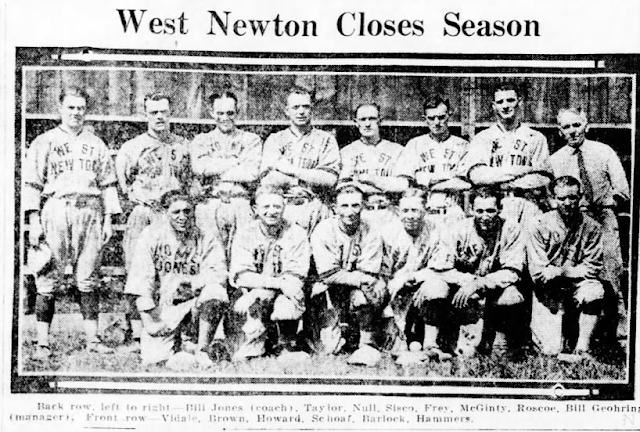
Danny Taylor of West Newton was the top batter of 1924. In 41 games he hit .507 with 22 home runs, 11 doubles, 38 singles, and 32 walks. He would go on to play in the major leagues for nine seasons, hitting .297 with some power. According to the Uniontown Morning Herald in 1926, as quoted in his SABR bio, he also hit 19 home runs for West Newton in 1925, including two in one inning. West Newton had a record of 27-13-1 in 1924. 
Pittsburgh Post, 1924-9-7, p.26


1924 was also marked by the rising number of college players on the sandlots. Impressed by the success of college men in the majors and the growing quality of play at the colleges, the sandlot teams were eager to sign college stars. Bellevue, one of the best teams, had two University of Pittsburgh men on their pitching staff in the Steve Swetonic and Alf Schmidt. Duquesne University had about a dozen of its players with Pittsburgh teams, and the University of Pittsburgh had at least half a dozen of their other players in addition to Swetonic and Schmidt starring in semi-pro. Other colleges represented on the sandlots included Penn State, Bucknell, Bellefonte, Saint Francis, and Waynesburg. (1924-7-06)

George "Ziggy" Walsh, star catcher for the Braddock Elks, set a mark for toughness. On July 27th it was noted he had not missed a game behind the plate all season - very impressive for a catcher. But his mettle was truly tested on September 2nd. The Elks were playing against Millvale in an elimination series game they desperately needed to win. Walsh had a broken finger, but as the Elks had no other catcher he unwound his bandage, set aside his splints, and caught the game. The Elks were three-hit by Leo Carroll and lost 4-2, but it was still a game of glory for Walsh.  (Note box)

Pittsburgh Post, 1925-5-31, p.33

The Harmarville Consumers had a strange pair in their second baseman Frank Anthony and their catcher Bill Schulties. Schulties was well over six feet tall, the tallest player in the district, while Anthony was not even five feet tall. 

Pittsburgh Post, 1924-9-7, p.26

The article of September 7th reported that "Anthony is considered by many as the best lead-off man in local ranks, having a hard stance at the plate which makes pitching to him a hard proposition, and along with it Frank is an eagle eye at looking the ball over and hits hard and timely. Schulties is the team's steady catcher and this year has been going great, having worked a majority of the games back of the bat for Cliff Barton's team." 
    They stuck together the next year, both signing to play with Homewood. (1925-3-22)

Another feature of the Pittsburgh sandlots were the old major leaguers, past their prime but still playing for the fun of it. They didn't play for any of the top teams, but the fact that they were still out on the diamond at all is impressive. 

Pittsburgh Post, 1924-7-27, p.24

At 49, the all-time great Honus Wagner was the regular first baseman for the Carnegie Elks. Former Pirate pitching star Deacon Phillippe kept busy at 52 by umpiring, scouting for the Pirates, and pitching a game from time to time. Dutch Jordan, 44, who had played for the Brooklyn Dodgers in 1902 and 1903, was now a policeman, and played second base for Brentwood. Frank Killen who had won 36 games for the Pirates in 1893, but by 1924 was 53, was reported in the article to have thrown two scoreless innings just the previous week. (I was not able to find any other reports of him playing in 1924.)

Monday, December 11, 2023

"All the Yiddished mamas": The story of Eddie Gottlieb


Brooklyn Times Union, 1935-8-14

It is no surprise that so many fine daughters of Yiddished [sic] mamas were flung before Eddie Gottlieb, for he was a great man indeed; perhaps the most powerful man in Philadelphia and New York in respect to semi-pro and Negro League baseball for many years, and elected to the National Basketball Hall of Fame in 1972. 

Eddie Gottlieb

Gottlieb was born in Kiev, Ukraine, in 1898, as Isadore Gottlieb, the only son of Morris Gottlieb. His father owned a candy store. His family moved to Philadelphia when he was ten, and he soon changed his name to the more gentile moniker of Edward. After just a few years in Philadelphia his father died, and Edward became the man of the house. Gottlieb played basketball and semipro baseball while attending the South Philadelphia High School, and after his graduation he founded a semipro basketball/baseball team, along with his friends Harry "Chick" Passon and Hugh Black. 

The team was soon titled the South Philadelphia Hebrew Association club, but they were usually called the SPHAs. The SPHAs would later become one of the leading basketball teams in the country under Gottlieb's leadership, winning three straight Eastern Basketball League titles (1929-30 to 1931-32) and a total of seven American Basketball League titles between 1933-34 and 1944-45. He was their coach until 1946. 

In the early 1920s they were just a local team, playing in the Philadelphia League, but those were the club's best years in baseball. 

The SPHAs peaked on the diamond in 1921 and 1922 under Gottlieb's management. They were solid in 1921, beating the Cressona Tigers, Cuban Stars, Hilldale, Indianapolis ABCs, Parkesburg Iron, American Chain, Camden, Bridesburg, House of David, and Lincoln Giants, according to the Wilmington Morning News. (1921-9-03, p. 11)

A game-used 1920s SPHAs baseball warm-up jacket. Note the Hebraic lettering, which spells SPHA from right to left. This picture is taken from the auction house Mile High Card Company.

 In September 1921, they played a well-attended series against the Old Timers for the championship of South Philadelphia. All games were held at the corner of Thirteenth and Johnson, the field the SPHAs shared with the Old Timers. Managed by Jack Hines, the Old Timers were a decent team. Their center fielder and lead-off batter was Johnny Castle, a 41-year-old who played in three games for the Philadelphia Phillies in 1910 and spent 1920 with the Wilson Bugs of the class B Virginia League. One of their pitchers, Bill McKenty, won 15 games with a 3.28 ERA for New Haven of the Eastern League in 1925.
 
The Old Timers won the first game 4-3 on September 2nd, in front of "the largest crowd that ever witnessed a game in South Philadelphia." The game ended in a most frustrating manner. The SPHAs had scored two runs with only one out in the top of the 8th to take the lead 5-4, but the game was called and the score reverted to 4-3. Eddie Gottlieb was not happy. He, quite understandably, believed the first game should not have been counted a loss for the SPHAs, and said the teams should have appointed an arbitration committee to settle disputes like that. "He does not object to his team losing, but says so much money should never have changed hands on the way the game ended." (The Evening Public Ledger, 1921-9-05, p. 12) I guess there was plenty of betting. 

 The SPHAs won the second game 10-5, September 5 before an equally large crowd, but the Old Timers came back to win the third and fourth games 6-4 and 8-1 (September 10 and 24.)

Wid Conroy joined the Old Timers at third base for the third and fourth games. Conroy had been a regular in the American League from 1901 to 1911 with the Brewers, Pirates, Highlanders and Senators, but was 44 by 1921. 38-year-old Gabby Street, Walter Johnson's former catcher, caught for the Old Timers in the 3rd game -- the team truly deserved its title. 

Box score of the third game, displaying the antediluvian line-up of the Old Timers.

The SPHAs won the fifth game of the series, but the series fizzled out after that: the SPHAs wanted to play further, as was "virtually agreed upon," and fight for the series which had been essentially stolen from them by the unjust calling off the first game, but the Old Timers were content with their 3-2 lead. It doesn't seem like any more games were played in the series. 

In 1922 the SPHAs joined the new-born but competitive Philadelphia Baseball Association, assigned to the Southern Division. Gottlieb put together a strong team, and they were successful from the start.

On May 1, opening day, before a huge crowd of about 10,000 fans, the SPHAs beat Hilldale 6-4 on the strength of a five-run sixth inning. Hilldale had Hall of Famers Judy Johnson at third, Louis Santop at catcher, and other solid Negro League players such as George Johnson, Otto Briggs, Phil Cockrell, and Harry Kenyon. The SPHAs had exactly zero players you would have heard of before reading this. 

The SPHAs would go on to beat Hilldale 8 to 6 (July 12), 5 to 4 (July 27), and 6 to 5 (June 21), when Lefty Vann threw a 2-hitter but walked a number of batters. Hilldale did beat the SPHAs at least once (I don't have a complete list of the games played by either team), when on June 13, before almost 10,000 fans, they demolished the SPHAs 9 to 3. 

According to the York Record (1924-2-12 p. 8), Elwood Krepps beat Hilldale four times in 1922. If that's correct, the SPHAs beat Hilldale at least two more times, because two of the SPHA-Hilldale wins came from Rube Chambers and Lefty Vann. 

The SPHAs also played a series with the Atlantic City Bacharach Giants, who were managed by future Negro League star Dick Lundy, then only 23 years old. As of August 9th, the SPHAs were up five games to one in their series. 

Thus, the 1922 SPHAs had a combined (probably incomplete) record of 9-2 against two teams who the next year would combine for a 60-46 record in the "Major League" Eastern Colored League. The comparison isn't quite fair, as both teams improved their rosters in 1923; Hilldale added HOF super-stars Biz Mackey and John Henry Lloyd, and the Bacharach Giants added a few semi-stars. It's still an impressive testimony, both to the quality of the 1922 SPHAs and the possible over-rated status of the Negro Leagues. 

1922 SPHAs

Elwood Krepps, 1922. 

The SPHAs had a very impressive pitching staff, primarily consisting of Elwood Krepps, Lefty Vann, and Chick Passon. Passon was co-founder of the SPHAs, while Krepps and Vann were hired guns. Elwood Krepps had pitched for the Raleigh Red Birds of the Piedmont League in 1920 and 1921, and would be fairly successful in the New York - Pennsylvania League and New England League from 1924 to 1929. 

On June 29th, Krepps no-hit Camden City in a 3-0 win. 

Arnold "Lefty" Vann, who had a 4-10 record in the NYPL in 1924, was probably the worst of the staff. He often played first base.


Harry "Chick" Passon

Pitcher Chick Passon was also the star of the basketball SPHAs, scoring 17.7 points per game in 1925-26, second in the Eastern Basketball League. But his days with the SPHAs were numbered. Gottlieb, who must not have been particularly sentimental, traded him to the Washington Palace-Five club in 1927-28. In his baseball career, Passon would pitch for Medford of the Burlington County League in 1923, and the semi-legendary Doherty Silk Sox from 1924 to 1926. The Silk Sox' second baseman, Bennie Borgmann, was likewise a basketball star in the winter - and not just any star, but the top scorer of the time. He led 15 leagues in scoring in 12 years, and was inducted to the Basketball Hall of Fame in 1961. 

Passon also made his mark in black baseball. By 1923, he was managing two minor black teams, the Texas Eagles and Philadelphia Giants. In 1931, he founded a new team called the Bacharach Giants. The Atlantic City Bacharach Giants, the team he had played against with the SPHAs, had folded after 1929, so he borrowed the name for recognition. The Philadelphia Bacharach Giants mostly played independently; in their sole year in the Negro Leagues, 1934, they won 5 games and lost 20. They would play until 1942, and were Roy Campanella's first team. Sadly, Passon shot himself in 1954. Source: https://sabr.org/journal/article/harry-passon-philadelphia-baseball-entrepreneur/

The elimination contest of the Philadelphia Baseball Association began in late August. The SPHAs were lined up against the other Southern Division teams in a kind of round-robin; I'm not sure what the exact logic of it was, or whether it reached any conclusion, but it is fun to read about. 

In their first game, August 28, Elwood Krepps shut out Fleisher Yarn on two hits for a 2-0 SPHA win. Nearly 5,000 fans were in attendance. The SPHAs won their second game by another two-hit shut-out, this one dealt by Chick Passon to the South Phillies, great rivals of the SPHAs. The game was played at Shetzline Park, the South Phils' home park, and attracted more than 10,000 fans. 

The South Phillies were an extremely strong team made of Philadelphia semi-pro legends such as Dick Spalding, a soccer star who would hit .296 as the Philadelphia Phillies regular outfielder in 1927, when he was 33; Buck Lai, a Chinese-Hawaiian 3rd baseman who spent four years in the Eastern League and played for the Brooklyn Bushwicks for many years; Howard Lohr, who played briefly in the majors in 1914 and 1916 and starred for many years in the semi-pros; Mike Pasquella, first baseman who in 1919 played one game for the Phillies and one game for the Cardinals; Pepper Peploski, short stop, who went 2 for 4 for the Detroit Tigers in 1913; and long-time pitcher-outfielder-first baseman Herb Steen, who had a .455 SLG in 33 games for the AA Syracuse Stars in 1922. 

In their return match with Fleisher Yarn, September 5th, the SPHAs were defeated 6-3 before 8,000 fans. On September 7th, due to bad weather, a mere 6,000 showed up to watch the SPHAs get shutout 4-0 by Jeff Tesreau, former New York Giants pitching star, in a rematch with the South Phillies. 

And that was it for the Philadelphia Baseball Association that year, as far I know. Hopefully it won't be long before I can update this with something definite. 

In 1923, Gottlieb focused on the basketball team, and the baseball team was consigned to mediocrity. It ceased to play after 1925, but was revived in 1933, and played for three more years before finally quitting. During this time, as has been summarized earlier, the basketball SPHAs became one of the top teams in America. 

But Gottlieb hadn't abandoned baseball. 

 In 1920, Passon, Gottlieb, and Black had opened a sporting good stores creatively called PGB Sports.

Ad placed in Philadelphia Evening Public Ledger, 1921-9-30, p. 21

After a few years Gottlieb, along with Black, sold out to Passon. but he put the connections with Negro League baseball he had made through the store to use. As his SABR bio states, "He became the leading booking agent for all Philadelphia sports, black and white." He was also the eastern booking agent for the Negro Leagues. 

And in the early 1930s, together with Ed Bolden, former owner of Hilldale, Gottlieb founded a Negro League team of his own: the Philadelphia Stars. The Stars joined the New National League in 1934, won 39 games and lost 18 in the regular season, and beat the Chicago American Giants 4-3-1 in a play-off to win the pennant. They never won another pennant, though they played through 1952. 

Basketball went major league with the founding of the Basketball Association of America in 1946, and Gottlieb was one of the founding fathers. He coached the Philadelphia Warriors to the 1946-47 championship, becoming the first champions in NBA history. (The NBA was created by the merging of the BAA with the NBL in 1949. Gottlieb played a significant part in the merger, and the NBA considers the BAA as part of its own history.)

He was the coach of the Warriors through 1954-55, and their general manager until 1964. 

According to Wikipedia, (I feel no shame in using Wikipedia as a source for basketball history),

"Gottlieb was behind the NBA's "territorial draft" rule, which gave teams the right to claim a local college or high school player in exchange for giving up their first-round draft pick. The rule was particularly advantageous for Philadelphia, which landed Overbrook High School's Wilt Chamberlain in 1959 after his stints with the University of Kansas and the Harlem Globetrotters."

Not bad.

Wilt The Stilt after his 100-point game


Gottlieb bought the Warriors in 1952 for $25,000, and sold them in 1962 for a reported $625,000 to investors in San Francisco, where the team would become the Golden State Warriors. 

No "Yiddished mama" ever snared him with a daughter, and Gottlieb was a bachelor to the end of his days. 

He headed the NBA Rules Committee for 25 years, and was the league's only schedule-maker for over 30 years, until the year of his death in 1979. 

Pure Wikipedia again:

"I probably was responsible for more rule changes in pro basketball than any other man," Gottlieb told the Associated Press late in his life. "They call me in now because I’m the only one left who can connect things to the past, who knows why this rule was put in or why that one was thrown out."

He was elected to the Naismith Memorial Basketball Hall of Fame in 1972, and the NBA Rookie of the Year award is still named after him. 

I'll close with this: (Man, copying from Wikipedia is a relief after digging through 1920s Philadelphia newspapers all afternoon.)

 "Eddie Gottlieb was one of the real pioneers of professional round ball," Red Smith wrote in The New York Times. Wrote Lupica, "Eddie Gottlieb loved basketball. Maybe no one ever loved basketball quite the way he did."

Fellow Hall of Famer Harry Litwack stated: "Gottlieb was about as important to the game of basketball as the basketball."


Wednesday, November 22, 2023

George Ely: The One-Armed Wonder

From 1907 to 1910, George Ely was one of the best semi-pro second baseman in Southern California. A slick fielder, he hit for both average and power, and had a knack for making clutch hits. He also had no right arm. 
1909

Ely was a telegraph operator for the Salt Lake Railroad. He was born George Alphonso Ely in Glendale, California, April 29, 1888. When a young child, he lost his right arm falling between the wheels of a cart. 

Instead of letting his lack of an arm keep him from a baseball career, he became the oddest kind of player I've ever seen: a one-armed left-handed second baseman 

The last left-handed second baseman to play regularly in professional baseball was "Kid" Mohler, who still holds the all-time record for pro games played at second base, with a mark of 2871. 

I also think it's possible George Ely played without a glove, at least for part of his career. 

 The 1909 picture of him, shown above, depicts him wearing a glove and no one ever mentioned that he didn't, but I think he might have from two different newspaper accounts.

The Santa Rosa Republican, August 04, 1905, p.4:

"When not playing in the box the one-armed wonder is still more spectacular in the outfield, where he has not made an error during the season. It is marvellous [sic] to see him trap the falling ball between his empty sleeve, his breast, and his left hand. No drive is too hard for him to tackle and hold." 

He tackled fly balls between his chest, sleeve, and hand - he didn't catch them. 

The Corning Daily Observer, November 12, 1908, p.3:

    "Ely thinks that a one-armed man, while handicapped to a certain degree, should be as good a player as one with both arms. He says that a man loses time transferring the ball from his right to left hand, which he would not do if he caught and threw the ball with the same hand." 

A one-armed player wearing a glove loses more time than a two-armed player, as evidenced by Pete Gray. 

Ely may have bypassed that by not wearing a glove, and I'm highly intrigued by the possibility. The newspaper accounts really do make it sound like he didn't wear a glove, and his posing with a glove is not proof that he played with a glove for his whole career, or even at all. It's hard to solve ambiguities like this from the distance of 115 years. 

He didn't let his handicap get in the way at the plate, either. Lefty Gervais, who pitched five games for the Boston Braves in 1913, recalled in 1948 that "Ely used the stub of his right arm, cut off at the elbow, to steady the bat at the plate and then developed a very powerful swing when he met the ball using only the left hand and arm." 

His amateur career can be traced as far back as 1903, when he was only 15. By 1905, he was a star pitcher and outfielder for Los Angeles High School, and had already received pro offers. His batting heroics had also begun. On July 9, pitching for the Johnson Machine Works team, he homered and won 5-3. On July 23, playing for the Forest Heights team of L.A., he hit three triples in a 12-6 win. Forest Heights' pitcher, Andy Briswalter, would go on to pitch for the Los Angeles Angels of the Pacific Coast League from 1908 to 1910, winning 31 games and losing 24.
1905

In 1906 he pitched for the Dyas-Cline sporting goods team. He had converted to second base by 1907, and was playing with the Thistles of the Southern California League. On October 13, 1907, Walter McCredie, the manager of the Portland Beavers, took a day off to watch the Thistles play Santa Monica. McCredie was impressed by Ely, but didn't make him an offer because of his handicap. 

In 1908 he played for the Salt Lakes of the Southern State League, and tied for the team-lead in batting average with a .333 mark in 69 at-bats and 16 games. A teammate of his with the Salt Lakes, Whitey Hensling, was a pitcher and third-baseman in the minor leagues for eight years. 

The Los Angeles Herald, 1908-6-27, p.7: 

George Ely, the one-arm baseball player, is just as good playing pool as he is on the diamond. In a game last night at McCormick's, Ely gave cards and spades to the captain and came through with the fifteen ball every time. 

Not sure what that means, exactly, but it does sound impressive. Merriam-Webster defines the phrase "cards and spades" as "a liberal handicap", as in "could give him cards and spades and still beat him at his own game." I had never seen that phrase before. 


In August 1908 he turned down an offer to play for the Santa Cruz Sandcrabs of the outlaw California State League - why, I am not exactly sure. 

Over the winter of 1908-09 he played with the Salt Lakes/Maiers in the California Winter League, and on November 2nd he turned an unassisted double play. It appears that the Maiers were the exact same team as the Salt Lakes, but were sponsored by Edward Maier, owner of the Vernon Tigers and Maier Beer.

On January 18, playing for the Maiers in a game against the Azusas, with Harry Lelande, president of the PCL, Edward Maier, and Hap Hogan, the Vernon Tigers' catcher, all in attendance, Ely doubled, scored the only run of the 1-0 game, and made an outstanding fielding play when he "ran thirty yards backwards after a fly ball and received considerable applause when he grabbed it safely." The PCL spectators thought of recommending him for the PCL, but nothing ever come of it. The Maiers' pitcher, Elmer Rieger, pitched a few games for the St. Louis Cardinals in 1910 and won 119 minor league games in a career which he spent mostly in the Pacific Coast League and American Association.


The Maiers finished in third place in the California Winter League. Note: the caption says it's listing the players from left to right, but is actually listing them from right to left. 

He spent a few months starring for Caldwell, Idaho in 1909.

The Caldwell Tribune, May 01, 1905, p.5:

"The baseball season opened Sunday... When the game ended the score stood nine to one in favor of Caldwell. Ely, the one-armed wonder, made more than good; he now hails from Caldwell."

He continued to play with the Maiers on his return to California. They won the California Summer League pennant, and as of September 30 had won 31 of their last 37 games. 

On April 24, 1910, playing for the Dyas-Cline club against the Los Angeles Grays, a black club, he smote a walk-off double in the bottom of the 10th to win the game 5-4. 

He was at second base for the Doyles, February 19, 1911, and did good work. The Doyles' pitcher, Oscar Jones, won 44 games for the Brooklyn Dodgers from 1903 to 1905, and won 226 minor league games. He was not in pro ball in 1912, but would win 24 games against eight losses for the Stockton Producers of the now class-D California State League in 1913. 

Ely broke his leg later in the year, and a benefit game was played for him at Vernon on December 16. Hap Hogan acted as umpire. 

I can only find one more record of him playing after that, but his career disappeared with a bang:  on April 21, 1912, for the Venice Ship Cafe club, he turned a sensational double play in the ninth inning and won the game with a walk-off triple in the bottom of the 10th. 

He continued to work as a telegraph operator. In 1918 he was working for the Salt Lake Railroad, as he had during his career, but by the 1940s he was working for the Union Pacific Railway.

He died June 25, 1967, in Newport Beach, California, at 79. 

George Ely's career was brief and he is now long-forgotten, but he deserves to be remembered. Though he was one-armed, he was no novelty player. He was a very good hitter and fielder in difficult semi-pro competition. Many of his teammates and opponents played in the minors and majors. He received pro offers, and would have received more if he had two arms. 

I hope to bring him back from obscurity with this post, at least in a small way. 


Andrés Tanaka of Palaú

 I was paging through The Mexican League  encyclopedia by Pedro Treto Cisneros when I chanced upon the exquisite name of Andrés Tanaka, outf...