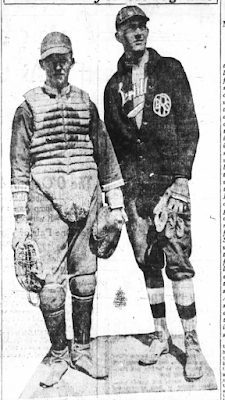
Ray Koch was always daring. He would give fans "the heebie-jeebies trying to turn singles into doubles" , and was apt to field balls hit to 2nd base "while turning a flip-flop or while sliding on his ear." And no one was Joe Gordon's regular double-play partner longer than him - Gordon was never paired so close or so long with Phil Rizzuto or Frankie Crosetti.
Ray Koch & Joe Gordon first played together in high school and Junior American Legion ball in Portland. They were inseparable as amateurs - the only time they were not on the same team was in 1933, when as college freshmen Gordon played for the University of Oregon and Koch played for Western Oregon University. Koch transferred to the University of Oregon in 1934, and for two years they were "Oregon's greatest collegiate infield combination in history." Oregon won the Northwest Conference both years. In 1935 Gordon (.415) was named All-Conference shortstop and Koch (.319) was All-Conference second baseman. Gordon was All-Conference shortstop in 1934, but as I am unable to find the list I don't know whether Koch was also All-Conference. As Koch led Oregon with a .370 average, he probably was.
In the summer they played in the Oregon State League - for Ray Brooks' West Side Babes in 1932, the Salem Senators in 1933, the Eugene Townies in 1934, and the Hop Golds in 1935.
As of August 22, 1934, Gordon was hitting .420 for the Townies and Koch was hitting .405.
By 1935, major league scouts thronged the stands to watch them, and before the end of the year Koch & Gordon had both left college and signed with the New York Yankees. Their coach at the University of Oregon, Howard Hobson, unsuccessfully tried to convince them to finish school first, but they were too intent on their major league dreams to heed him.
They left college and signed with the Yankees together, but their paths diverged from there. In 1936 Gordon was sent to Oakland of the Pacific Coast League, where he hit .300. By 1938 he was the starting second baseman for the New York Yankees, and was on his way to the Hall of Fame.
By 1938, Ray Koch was "working in Portland". In 1936 he had been sent to class-C Joplin, and hit .261 without power. He also hurt his knee. He never played in pro ball again.
Ray Koch & Joe Gordon first played together in high school and Junior American Legion ball in Portland. They were inseparable as amateurs - the only time they were not on the same team was in 1933, when as college freshmen Gordon played for the University of Oregon and Koch played for Western Oregon University. Koch transferred to the University of Oregon in 1934, and for two years they were "Oregon's greatest collegiate infield combination in history." Oregon won the Northwest Conference both years. In 1935 Gordon (.415) was named All-Conference shortstop and Koch (.319) was All-Conference second baseman. Gordon was All-Conference shortstop in 1934, but as I am unable to find the list I don't know whether Koch was also All-Conference. As Koch led Oregon with a .370 average, he probably was.
In the summer they played in the Oregon State League - for Ray Brooks' West Side Babes in 1932, the Salem Senators in 1933, the Eugene Townies in 1934, and the Hop Golds in 1935.
 |
| 1934-6-24, Eugene Guard |
By 1935, major league scouts thronged the stands to watch them, and before the end of the year Koch & Gordon had both left college and signed with the New York Yankees. Their coach at the University of Oregon, Howard Hobson, unsuccessfully tried to convince them to finish school first, but they were too intent on their major league dreams to heed him.
They left college and signed with the Yankees together, but their paths diverged from there. In 1936 Gordon was sent to Oakland of the Pacific Coast League, where he hit .300. By 1938 he was the starting second baseman for the New York Yankees, and was on his way to the Hall of Fame.
By 1938, Ray Koch was "working in Portland". In 1936 he had been sent to class-C Joplin, and hit .261 without power. He also hurt his knee. He never played in pro ball again.
He continued to play in the Oregon State League and in 1941 he was joined on the Eugene Athletics by his younger brother, Barney Koch.
Barney Koch was just eighteen years old in 1941 when he joined Ray with Eugene. Barney had begun in the State League in 1940 with the Portland Babes, managed by Ray Brooks, the same team and the same manager that Ray Koch and Joe Gordon had begun with eight years earlier.

In 1942, as a college freshman, Barney became varsity second baseman of the University of Oregon, and by 1943 he had become the top amateur second baseman in Oregon. He spent that summer playing with the champion Portland Firemen of the Portland City League. The age of the average Fireman was a mere 18 years and two months, but they were utterly dominant. Up to July 27 they had won 11 games and lost one, scoring 142 runs and allowing 13. Barney Koch hit .583, with 35 hits in 60 at-bats. The only pitcher to beat the Firemen was a major league veteran, Sergeant Jack Knott of the Camp Adair Timber Wolves, who defeated them 4-0, July 16, in the final round of the Oregon semi-pro tournament. Koch was named the best infielder of the state tournament.
The champion soldier Timber Wolves were unable to travel to Wichita, Kansas for the national semi-pro tournament, so the Firemen represented Oregon in their place. Despite their youth and competition from teams with players such as Pete Reiser and Cecil Travis, the Firemen finished 7th nationally.
After the tournament Ray Brooks, "Mr. Oregon Semi-Pro Baseball himself" and manager of the Firemen, had eight of his players in the Dodgers try-out camp. The Dodgers signed one of them: Barney Koch.
In 1943, second base for the Brooklyn Dodgers had been manned by Hall of Famer Billy Herman, who hit .330 with 100 runs batted in and 193 hits. In 1945, Eddie Stanky would play second base for the Dodgers, scoring 128 runs on the strength of 148 walks.
1944 was a second-base Brooklyn trolley wreck. 10 different players spent time at 2nd, none starting more than 58 games there. The fill-in with the fourth-most starts at 2nd (26) was Barney Koch.

Koch had started the 1944 season with the International League Montreal Royals but was called up to Brooklyn in late July. In his debut on July 23, the first game of a double-header against the Pittsburgh Pirates, Barney batted lead-off and hit three singles. That would remain his major league career high in hits forever.
Just 21, Barney finished the 1944 season with a .219 average in 33 games for the Dodgers, and a .252 average with 48 runs scored in 82 games for Montreal. He hit 11 doubles, 2 triples, and 0 home runs. His most notable quality was probably his weight: weighing but 140 pounds, he was the lightest major leaguer of the 1940s.
In 1945, Koch declined to sign his Dodgers contract in order to attend college through summer.
Like his brother Ray, Barney Koch had left the University of Oregon to play pro baseball. Unlike Ray, he left the pros on his own terms: he quit the Dodgers and finished college.
But he didn't stop playing baseball. He spent 1945 playing with the Giustina Reds of the Cascade League. In 16 games he batted a sweet .313 with 20 hits, 13 runs scored, and 9 stolen bases. Surprisingly, given his customary lack of power, he also led the league in home runs, with 4.

 |
| Hit .416 with the Miller Lumbermen of the Cascade League in 1948. |
 |
| 1952: with the Roseburg Chiefs of the Southwestern Oregon League. |
 |
| Barney as Grant HS coach. |
Ray Koch became a golfer, and was the club manager of Inglewood Golf & Country Club of Seattle for a number of years. He died in 1978, Bothell, WA, at 65.
Barney Koch:
BR TR
HT 5'8" WT 140
BR TR
HT 5'8" WT 140
Born 1923-3-23, Campbell, Nebraska
Died 1987-6-06, Tacoma, Washington
Barnett Koch
Year Avg HR RBI H AB G R SB Tm Lg
1940 Portland Babes, Oregon State League
Died 1987-6-06, Tacoma, Washington
Barnett Koch
Year Avg HR RBI H AB G R SB Tm Lg
1940 Portland Babes, Oregon State League
1941 Eugene Athletics, Oregon State League
1942 .339 21 62 15 Portland Firemen, Oregon State League
1943 .583 35 60 12 Portland Firemen, Portland City League
1944 .252 0 21 71 282 82 48 7 Montreal Royals, International League
1944 .219 0 1 21 96 33 11 0 Brooklyn Dodgers, National League
1945 .313 4 20 64 16 13 9 Giustina Reds, Cascade League
1946 .362 15 25 69 16 15 Giustina Reds, Cascade League
1947 Portland McElroy Dancers
1948 .416 37 89 16 Miller Lumbermen, Cascade League
1949 .389 21 54 Roseburg Chiefs, Southwestern Oregon League
1951 Coos Bay - North Bend, Southwestern Oregon League
1952 Roseburg Chiefs, Southwestern Oregon League
1953 Drain Black Sox, Southwestern Oregon League
Here's a link to all the sources I used to write this post, including some extra material that I didn't include:
https://semiprobaseballdatabase.blogspot.com/2023/09/barney-koch.html
Here's a link to all the sources I used to write this post, including some extra material that I didn't include:
https://semiprobaseballdatabase.blogspot.com/2023/09/barney-koch.html